
Imagine you wake up to a sudden price move in Bitcoin and need to execute a trade within minutes. Your phone has biometrics, your laptop has saved passwords, and you’ve got funds split between an OKX custodial account and your non‑custodial Web3 wallet. Which path gets you to the market fastest without sacrificing safety? This is the everyday tension: speed versus control. In the US context — where KYC, regulatory friction, and operational security are all active constraints — understanding how OKX’s wallet options, verification flow, and trading interfaces interplay is more than technical trivia; it directly shapes execution, custody risk, and compliance exposure.
Below I compare the main alternatives a US trader will use on OKX: the custodial account (CEX) protected by OKX’s platform, and the non‑custodial Web3 wallet that gives full key control. I’ll unpack how each works, where they break, the trade‑offs for logging in and trading, and practical heuristics for choosing the right path in different scenarios.
How each approach actually works (mechanisms, not slogans)
Custodial account (OKX CEX): you create an OKX account, complete Identity Verification (KYC) with a government ID and a facial liveness check, then deposit funds on the platform. Funds are held in accounts under OKX’s custody; withdrawals require on‑platform authentication and withdrawal approvals. OKX augments security with military‑grade encryption, an AI system that flags suspicious logins, mandatory Two‑Factor Authentication (2FA) using SMS, Google Authenticator, or biometrics, and cold storage where over 95% of assets are kept in multi‑signature, air‑gapped wallets. OKX also offers Proof of Reserves (PoR) so you can verify the exchange’s on‑chain backing of deposited assets.
Non‑custodial Web3 wallet: the OKX wallet option is self‑custodial; you generate and retain a seed phrase or connect a hardware device like Ledger/Trezor. Trading via this route typically uses the DEX aggregator, bridging liquidity across chains and interacting directly with DeFi protocols. You retain private keys and control, but the responsibility for seed phrases and smart contract interactions falls solely on you.
Logging in and verification: speed, friction, and risk
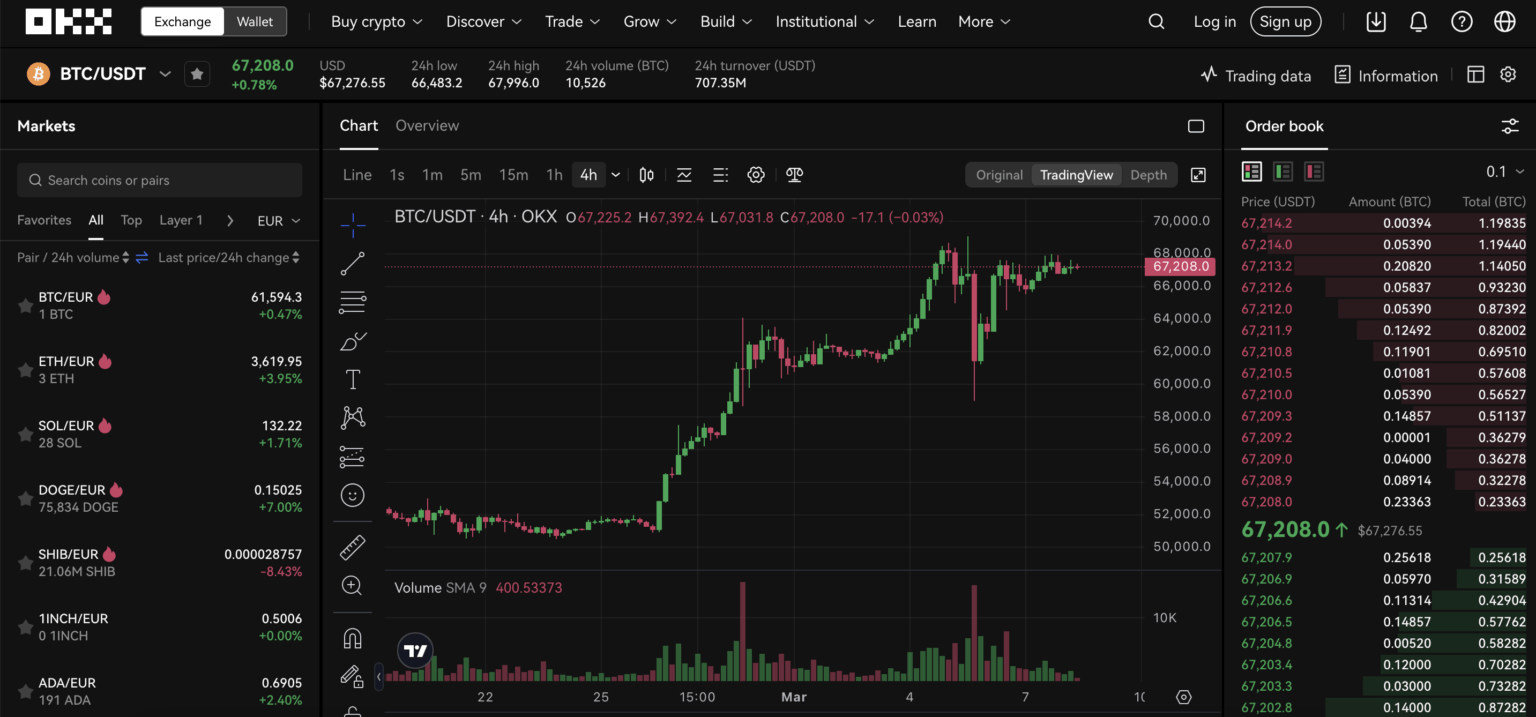
Which is faster? Logging into a custodial OKX account — once KYC is complete — is usually fastest for executing trades: you can fund via bank transfers, cards, or on‑platform stablecoins immediately, use TradingView charts, and access spot, margin, or derivatives from one dashboard. The weekly app messaging emphasizes OKX’s aim for quick fiat and crypto movement and notes broad global user adoption; that signals continued product investment in streamlined login and mobile biometric flows.
But the speed comes with friction up front. US users must complete KYC (ID and liveness check) to enable full functionality. KYC can take minutes to days, depending on document quality and downstream review. If you are a trader who needs immediate access without passing KYC, your options are constrained: non‑custodial wallets let you interact with DeFi and the DEX aggregator without KYC, but not with fiat on‑ramps, centralized derivatives, or custodial staking facilities.
Trading choices: when to use the CEX versus your Web3 wallet
Use the custodial OKX account when you need: low latency access to order books, high leverage products (up to 125x on certain derivatives), quick fiat on/off ramps, or integrated staking and yield tools that automate rewards and auto‑compound. The trade‑off: counterparty custody risk (mitigated but not eliminated) and regulatory exposure through KYC.
Use the self‑custodial wallet when you want: absolute key ownership, direct access to DeFi yield farms, cross‑chain swaps via OKX’s DEX aggregator, or NFT marketplace interactions with creator‑royalties preserved. The trade‑off: you assume irreversible key management risk (lose the seed phrase = lose funds), and interacting with DeFi introduces smart contract and liquidity risks that platform protections won’t cover.
Security trade‑offs, failure modes, and a realistic mental model
Security is not binary. A helpful mental model: custody and platform protections reduce some classes of risk (exchange hacks, simple user error in on‑platform transfers) but introduce dependencies on the platform’s operational integrity and on its compliance environment. Non‑custodial wallets remove the platform dependency but place all risk on the user’s operational security and on the external smart contract ecosystem. Both face common external threats: phishing, credential stuffing, and social engineering.
Two concrete failure modes to keep in mind: (1) KYC/Account Lock: an account flagged for suspicious activity could be temporarily restricted; your funds are still on the platform but inaccessible until resolution. (2) Self‑custody loss: misplacing a seed phrase is typically permanent. Neither is theoretical — both have real costs and different operational remedies.
Practical heuristics for US traders
Heuristic 1 — Speed with managed risk: If you trade frequently and rely on order‑book depth and derivatives, use the custodial flow but harden the account: enable hardware 2FA where possible, register safe withdrawal addresses, and insist on device‑bound biometrics for mobile access. Keep only active trading capital on the exchange; transfer long‑term holdings to cold storage or a hardware wallet.
Heuristic 2 — Control with caution: If your priority is self‑custody and interaction with DeFi, keep smaller capital on hot wallets for trading and swap operations, and store larger balances in a hardware wallet integrated with OKX’s non‑custodial option. When you connect to DApps, prefer audited contracts, review aggregated routing paths from the DEX aggregator for expected slippage, and treat smart contract interactions as irreversible.
Heuristic 3 — Hybrid approach: Many experienced traders use both. Use OKX’s custodial account for fiat rails, derivatives, and staking with PoR transparency; use the Web3 wallet for DeFi yield and NFTs. Moving assets between the two requires operational discipline — verify addresses, double‑check chain selection (OKX supports 130+ native blockchains), and allow for network fees and potential cross‑chain delay.
Where this system breaks or becomes costly
Watch these boundary conditions: massive market volatility increases slippage and order execution risk, especially on low liquidity pairs; margin and leverage amplify both gains and losses (10x on margin, up to 125x on certain derivatives — higher leverage magnifies liquidation risk); and cross‑chain bridges can fail or be exploited, exposing transfers to smart contract risk. Proof of Reserves improves transparency, but it does not eliminate operational, legal, or custodial restrictions on withdrawals during emergency incidents.
Decision‑useful takeaway: a simple checklist before you act
Before you log in and trade, run this quick checklist: (1) Which custody model do you need right now — immediate order book access or key control? (2) Is your KYC done and your 2FA hardened on the custodial side? (3) If using a Web3 wallet, is the destination contract audited and liquidity sufficient? (4) How much capital are you willing to risk on leverage or on hot‑wallet transactions? These four questions reframe many execution errors as predictable trade‑offs rather than surprises.
If you need to reach the OKX web login with the most direct path after confirming your operational setup, use this link to access the official login flow: okx sign in.
FAQ
Do US users have to complete KYC to trade on OKX?
Yes — to use fiat on‑ramps, custodial derivatives, and full withdrawal features, US users must complete KYC including a government ID and facial liveness check. You can still use non‑custodial wallets and many DeFi features without KYC, but those paths exclude fiat rails and certain centralized products.
Is OKX safe for holding large balances?
OKX stores the majority of assets in multi‑sig, air‑gapped cold storage and offers PoR for transparency, which reduces some institutional risks. That said, “safe” depends on threat models: for absolute control, self‑custody with hardware wallets remains the gold standard, while custodial storage trades control for convenience and platform‑level protections.
Can I use OKX’s Web3 wallet with hardware devices?
Yes. The OKX non‑custodial wallet supports integrations with hardware devices like Ledger and Trezor, which is useful for minimizing hot‑wallet exposure while retaining Web3 functionality.
What risks should I watch when using OKX’s DEX aggregator?
Key risks are route slippage, low liquidity on some cross‑chain pairs, and smart contract vulnerabilities. The aggregator helps find efficient routes, but it cannot eliminate on‑chain execution risk; always check expected slippage and transaction fees before confirming.
Final thought: OKX offers complementary tools — a feature‑rich custodial exchange with strong platform protections and a non‑custodial Web3 wallet with broad cross‑chain reach. The smarter trade is rarely choosing one as the single answer; it’s choosing the right tool for the market situation, aligning it with your security posture, and treating transfers between custody domains as deliberate, audited operations rather than afterthoughts. Monitor verification status, keep control of critical credentials, and treat leverage and cross‑chain bridges with measured skepticism — the market pays you for speed, but it penalizes sloppiness.